
Pelaa Sister Sites: Former Genesis Casinos and Brand History
Pelaa’s Casino Cruise, Casoola, Casino Lab, Spela, Genesis Casino and Casino Masters relationships belong to the former Genesis Global network. A current UK Pelaa service and sister list have not been established. Its Viking illustration, named games and former reward structures remain useful history, separated from present licensing and availability.






Pelaa’s six historical Genesis products

These six profiles describe the former Genesis Global products. They are not a verified current UK sister list. Their different settings and product emphases explain the original comparison, while old catalogue totals, offers and contact claims belong to that earlier period.
Casoola: a robot story around a familiar casino

Casoola’s original concept involved a virtual-reality mishap that brought a large robot into London. Its cartoon style and inverted real/virtual worlds supplied a much more elaborate story than Pelaa’s comparatively restrained Viking scene. The earlier review likened it to television science-fiction comedy; that was a visual comparison, not evidence of a formal entertainment licence.
The old product description quoted around two thousand casino games. That total belonged to the period and did not establish that every version or supplier was unique. The strong character world could make the site memorable without changing the basic operation of a familiar slot.
This is the distinctive historical comparison: an extravagant robot narrative around a conventional casino framework. It does not identify the operator of a later Casoola-branded website or establish a current relationship to Pelaa. The original logo and theme remain useful history without becoming a present joining recommendation.
Casino Cruise: the early liner identity
The earlier Genesis history identified Casino Cruise as its 2014 debut brand. The product committed to a luxury-liner setting, extending the idea into support staff described as “cabin crew” and promotions framed as a voyage. That coherence was the original review’s strength, rather than a claim that a cruise theme improved returns.
The recorded catalogue contained around two thousand games, mostly slots. As with Pelaa, the number was an older snapshot rather than a permanent measure of variety. A familiar game could appear in both collections even though one site used Viking artwork and the other a ship.
The chronology and theme explain why Cruise appeared repeatedly in the former family comparisons. They do not prove current British availability, continued account terms or a modern common operator. The liner profile belongs to the historical product account, with its complete genuine logo identifying the earlier brand.
Casino Lab: a laboratory and steampunk concept

Casino Lab’s original identity combined a professor’s laboratory with steampunk machinery. The old review connected that visual world with Fortunium, a game whose industrial fantasy made it a natural thematic example. The setting was different from Casino Planet’s futuristic-city narrative and Sloty’s floating city.
The laboratory also suggested that players could create something in the fictional studio. The original assessment did not demonstrate a real player-controlled creation feature, so that suggestion should remain part of the theme rather than a verified product tool. A developed story did not establish a different underlying operator or game catalogue.
Compared with Pelaa, the useful distinction was the industrial fantasy versus a Viking setting. That is enough to explain the old product without inventing a present catalogue, current bonus or continuing British sister relationship from the logo alone.
Spela: Scandinavian naming and a quieter casino design

Spela’s name is Swedish for “play”, matching the meaning of the Finnish Pelaa. The earlier company review used those names to explain localisation towards Scandinavian audiences. The linguistic connection did not make them twin websites or establish a closer legal relationship than either had with the rest of the former Genesis family.
Its original presentation was comparatively restrained, with a playing-card symbol and a more conventional casino atmosphere rather than robots or fantasy fighters. That was a useful contrast for a reader who preferred a quieter interface. It was not proof that table games were statistically more popular there.
The old thematic judgement and localisation history remain meaningful. They do not establish today’s supported languages, currencies, rooms or licence at a later service. The former shared framework and each brand’s different visual emphasis should remain separate parts of the explanation.
Genesis Casino: a space-themed former flagship
Genesis Casino’s name and outer-space setting presented it as the former operator’s central brand. The original review found that identity more expansive than the practical differences it could establish: its approximate two-thousand-game catalogue overlapped heavily with other products in that period.
The specific promotional distinction was an earlier weekly cashback offer. That was different from a matched first deposit, but the percentage, qualifying-loss definition and limits were needed before calculating its value. A cashback label did not make every loss refundable or show that the catalogue had better returns than Pelaa’s.
The useful historical comparison is therefore the space identity plus a different recurring reward model. The flagship name alone was not evidence of a universal service advantage. Nor does its old Genesis connection establish the operating company, terms or current British availability of a later website using the same identity.
Casino Masters: the elaborate fighter narrative

Casino Masters’ earlier world featured six elemental warriors fighting apparently immortal opponents. One winged character reminded the original reviewer of a familiar fighting-game figure. That was a resemblance described by the writer, not proof of a licensed connection to Tekken or another video-game series.
The fantasy-fighter concept was more elaborate than Pelaa’s Viking scene and supplied a strong visual identity. The original reservation was comparatively lighter promotional detail than at several former sisters. Attractive characters and a developed backstory did not establish a larger reward or resolve the need to read its conditions.
As a historical comparison, it shows how different-looking brands could sit above the same operating framework. Its logo and narrative remain worth understanding without implying that the former casino is currently authorised for UK players, shares a present cashier with Pelaa or can still honour an old welcome package.
Pelaa information
| Question | Evidence |
|---|---|
| Former operator | Genesis Global Limited |
| Former product | Viking-themed casino with slots and live games |
| Current UK service | Not established; secure access at the old domain could not be verified |
| Historical comparisons | Casoola, Casino Cruise, Casino Lab, Spela, Genesis Casino and Casino Masters |
| Earlier company account | Genesis’s former British relationship is history, not present permission |
| Use of this review | Specific original product, reward and service evidence, clearly separated from current availability. |
Genesis Global: the history behind Pelaa

The earlier operator profile dated Genesis Global’s Maltese origins and Casino Cruise launch to 2014. That chronology explains why the cruise-liner identity recurs in the old family. Later products developed more elaborate visual stories, including Pelaa’s Viking setting, Casoola’s virtual-world accident and the fantasy fighters of Casino Masters.
The original network description also distinguished market localisation. Pelaa’s Finnish “play” name and Spela’s Swedish equivalent were examples of that approach. They did not make the two brands twins or establish a separate company behind each country-oriented identity. A regional name, currency and welcome can change while the operating relationship remains shared.
The old article’s claim that the company was on a path of almost constant success is not a suitable current account. Nor are its twenty-brand total and predictions about future sport launches permanent facts. FunBet’s earlier launch and subsequent withdrawal were part of that history, not evidence that every later website using the name belongs to the old Genesis business.
The regulatory chronology needs its own correction. The Gambling Commission announced a £3.8 million penalty, warning and further audit condition on 27 January 2022. The earlier suspension had been lifted on 14 October 2020. The old £3.4 million/December 2021 account was inaccurate. Those events concern the historical licensed business and do not authorise a current Pelaa service.
The former British account no longer supplies a live public licence record at its old address. The old Pelaa domain also could not be securely verified during the present check. Neither observation identifies the owner of a later site or gives a precise closure date. The appropriate conclusion is narrower: no current UK Pelaa operator and sister list have been established here. That leaves ample room to explain the genuine former product without inventing a reopening or a current licence.
Pelaa: historical product, promotions and cashier
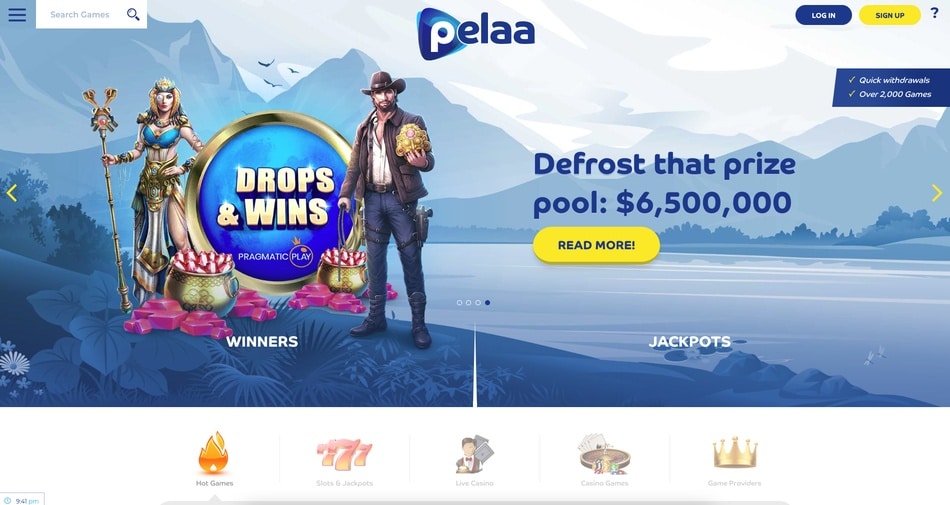
The authentic illustration shows a pale Viking-and-ice scene with a Drops & Wins headline of $6,500,000. That is a historical prize-pool presentation, not a current British welcome, an individual jackpot promise or proof that the casino is accessible now.
The original matched welcome and its separate components
The old review described a first-deposit match capped at £100, fifty spins and a minimum £10 qualifying deposit. E-wallet funding was excluded in that version. Its forty-times requirement applied to the bonus funds and spin winnings. The earlier statement that a later current cap could simply be substituted would have created a different offer, so the old terms remain explicitly historical.
A £20 matched deposit under that recorded 100% formula meant £20 cash and £20 starting bonus. Forty times the bonus alone would imply £800 of qualifying bonus turnover, before considering any spin winnings and the precise contribution rules. That is arithmetic about an expired structure, not a recommended funding amount or a guarantee that the combined balance could be withdrawn.
The fifty-spin count is another component. Without its allocated stake and actual game outcomes, it cannot be turned into a cash value. An e-wallet exclusion also concerns qualification, not necessarily whether the same payment brand was later available for withdrawing a real-money balance. Keeping those questions separate makes the historic promotion more intelligible than calling every element “free”.
Tuesday spins and Wonderful Weekends
The old recurring schedule offered a changing allocation of Tuesday spins to players who had deposited at least £10 during the preceding week. The number and game varied. The second recorded reward, Wonderful Weekends, was a 25% deposit boost capped at £100 for players who had deposited £50 or more in the prior week, with the invitation arriving on Thursday.
Those prior-week qualification deposits and a subsequent matched deposit were not necessarily the same transaction. At a simple 25% match, a £40 qualifying rewarded deposit would produce £10 of starting bonus, while reaching a £100 cap would require £400 under that formula. The example explains the percentage; it is not a reason to chase a larger award or assume every account qualified.
The earlier page contradicted itself by saying the weekend reward had the “same” ten-times rule as a welcome it had already described at forty times. The contradictory wording does not establish one reliable multiplier for that historical reward, so a precise turnover calculation for that package would be unsupported. Tuesday allocations and Thursday invitations explain the earlier promotional rhythm; neither is verified as available today.
Specific slots and the live-game alternative
The original game row named Yggdrasil’s Valley of the Gods, Play’n GO’s Troll Hunters 2, NetEnt’s Twin Spin and Play’n GO’s Legacy of Dead. It also included Evolution’s Crazy Time, which is a live-hosted game show rather than another reel slot. That selection explains more about the old product than a general claim that the network carried thousands of identical games.
Valley of the Gods was described through its respin sequence, while Play’n GO describes Troll Hunters 2 as a five-by-five cascading grid. Its Win Spins round introduces a two-by-two Troll Wild, with the chosen character affecting the wild multiplier and round structure. Twin Spin and Legacy of Dead supplied different familiar slot identities. Their rules define the actual reel or cluster mechanism; a shared “popular games” label is not evidence that players at Pelaa preferred them more than customers elsewhere.
Crazy Time changes the interaction to a hosted wheel and associated game-show rounds. It therefore answers a different product need from the slot collection. The Viking artwork gave the catalogue a common visual frame, but it did not make those supplier games exclusive or establish a special payout rate at Pelaa.
Support and the two historical payment stages
The earlier support description listed telephone 0800 0294558, live chat and email. Those were operating-period contact details, not newly verified current assistance. A familiar logo alone does not establish the correct present destination for old account documents.
Its cashier description promoted instant e-wallet and Trustly withdrawals after verification, with debit cards and Apple Pay taking one to three working days. Those were conditional published estimates, not completed withdrawal tests. Verification acceptance, operator release and provider receipt are separate stages. A claim of “instant” after accepted checks did not determine how long an outstanding document query might take.
The historical player reports below include MiFinity delays of more than a week. That does not prove every e-wallet failed, but it does show why the old advertised method estimate should not have been converted into a universal promise. The old product’s strong themes and familiar game formats remain useful history; present availability, operator identity and payment performance remain separate unverified questions.
What remains useful about the Pelaa comparison
Pelaa’s recorded identity combined a restrained Viking scene with a familiar supplier catalogue and recurring weekly promotions. Casoola and Casino Masters used more elaborate characters; Casino Cruise developed a coherent liner theme; Spela was quieter; and Casino Lab used a laboratory concept. Those are genuine distinctions in the earlier review rather than six interchangeable logos.
The limitations are equally specific: contradictory bonus multipliers in the old text, account-dependent payment claims and the absence of a verified current British service. A reader can understand the former product and its family without being told that a historical licence or an attractive illustration makes a later website equivalent.
Pelaa’s historical player feedback
The June 2026 summary described six public reports. It recorded MiFinity payments said to be delayed by more than a week, repeated verification requests, missing promotional extras and slow or scripted responses. Positive comments praised the game range and friendly help. These are individual historical reports, not a fresh count or independently verified account findings.
A former British licence does not authorise a later site using the Pelaa name. The historic Genesis relationship does not establish present permission. Likewise, a blanket claim of independently tested games did not identify a particular current game or resolve an allegation about results.
The useful service question is more concrete: which payment was requested, what documents had been accepted, and had the operator released it? A missing-reward question needs the actual invitation and qualifying record. Those distinctions give the historical complaints and praise context without treating either as proof of a current service, a universal payment speed or a manipulated game.