
mFortune sister sites
mFortune is closed in Britain. Its final Viral Interactive sisters were Pocket Win, Jammy Monkey, Luck.com, Lucky Casino and Mad Slots; its earlier In Touch family was different. Explore the original mobile casino, illustrated game catalogue and loyalty shop below.







mFortune’s two former sister-site groups

mFortune had two different British operator periods. Its final group under Viral Interactive included Jammy Monkey, Pocket Win, Luck.com, Lucky Casino and Mad Slots. The earlier In Touch Games family also included Mr Spin, Dr Slot, Cashmo, Bonus Boss, Casino 2020 and Slot Factory. Those earlier names did not all follow mFortune into the later group.
The distinction explains why older sister-site lists disagree. Pocket Win and Jammy Monkey appear in both periods, while Lucky Casino is easily missed from the later list. Viral Interactive’s current domain record lists six inactive addresses, including mfortune.co.uk. That leaves five other brands in its recorded group.
Pocket Win

Pocket Win was the closest historical comparison for mFortune’s original purpose. Both belonged to the period when a casino designed for a phone was a distinct product, rather than simply a desktop website squeezed onto a smaller screen. In Touch Games’ company history dates Pocket Win to 2010, three years after mFortune.
Its mix of bingo, slots and table games made it a better comparison for mFortune than the later sites devoted almost entirely to slots. It shared the practical, compact approach of the older network. It had less of the theatrical branding seen at Bonus Boss, but its longer history mattered more than a newer coat of paint. Pocket Win subsequently appeared under Viral Interactive as well, so it belongs in both chapters of the family.
Jammy Monkey

Jammy Monkey was a later addition to the In Touch group. The earlier site was noticeably plainer than its name suggested. Its restrained layout could appeal to somebody who found mFortune’s promotion banners and game tiles busy, although it did less with its character than Bonus Boss did with its gangster theme.
The important difference was presentation, not proof of a completely separate games collection. In Touch developed its own software, so the early Jammy Monkey belonged to that same development business. Its later appearance under Viral Interactive should be treated separately: the former operator connection alone cannot establish which games or account rules survived the change.
Luck.com, Lucky Casino and Mad Slots
These three names complete the later recorded group. They are useful for identifying mFortune’s final operator connection, but they were not part of its original In Touch mobile-casino family. In particular, Lucky Casino and Luck.com are separate entries. Combining them into one name understates the later group.
Older descriptions of Mad Slots concentrated on a more conventional slots lobby, while Luck.com had a broader international casino identity. That was a different background from mFortune’s small, purpose-built phone games. The regulator’s inactive British records establish the former connection; they do not establish that any present international service, revived domain or similarly named casino uses mFortune’s old terms or handles its balances.
How the earlier mFortune sister sites differed
In Touch’s smaller catalogues made design, bingo and promotions unusually important. A different logo did not always mean a completely different selection of games. mFortune’s advantage was the combination of several game categories with a recognisable loyalty shop, rather than the largest possible list of outside software suppliers.
Mr Spin

Mr Spin was the closest broader-casino comparison within the earlier family. Despite its slots-sounding name, it also offered roulette, bingo and other table games. Those extra categories made it more relevant to a mFortune player who switched between games than a narrowly focused slots site such as Dr Slot.
The breadth was relative. Its table-game and bingo selections were modest, and it did not suddenly become a large multi-provider casino because it had several categories. Its appeal lay in familiar mobile navigation and a manageable catalogue. mFortune still had the stronger overall identity, especially for customers interested in its bingo rewards.
Cashmo

Cashmo gave the family a bright green, browser-based casino with less emphasis on a character or elaborate setting. Its mobile focus was part of the wider In Touch approach, not a feature unique to Cashmo. The old homepage put a referral promotion above a colourful grid of original slots.
It was a straightforward comparison for someone who preferred that cleaner branding to mFortune’s busier purple promotion screen. It offered fewer obvious reasons to stay for a particular theme or rewards shop. Cashmo’s new-business closure was reported in February 2023, before the operator-wide licence surrender that September, so it should not be given the same opening and closing timeline as every relative.
Bonus Boss
Bonus Boss made the most of a character. Its cartoon gangster, often called the Don, gave the casino an identity that was much stronger than a colour scheme. The Spinfather carried the same idea into a slot and appeared in its historical promotions, linking the branding to an actual game.
That made it a more memorable themed alternative than Jammy Monkey, whose name promised more personality than its earlier layout delivered. It still belonged to the same in-house development network. The character did not make its wagering conditions easier or its withdrawals faster, and it did not reproduce mFortune’s particular combination of bingo and physical loyalty prizes.
Dr Slot

Dr Slot took the narrower route. It concentrated on slots, with a very small opening catalogue that grew during its operating history. Its doctor character helped make the brand recognisable, but it could not offer the same range of bingo and table games as mFortune.
The comparison has a useful award connection. At the 2019 WhichBingo Awards, Dr Slot won Best New Slots Site and mFortune won Best Slots Site. Those were different categories in the same year. They show that both attracted recognition, without turning a historical award into evidence of current availability or payment reliability.
Casino 2020

Casino 2020 attached its identity to a year rather than a character. That gave it a clear contemporary name when it arrived, but the name naturally aged. Its more durable feature was the compact collection of proprietary slots, which followed the wider In Touch approach.
It was consequently closer to Dr Slot than to the full mFortune mix. Somebody interested mainly in the operator’s slots could recognise the connection; somebody looking for bingo rooms and the loyalty shop would find the comparison less convincing. The year in its name is not evidence that it had a new operator or a new collection of games every year.
Pocket Win and Jammy Monkey in the earlier group
These were the two sisters that also appeared in the later Viral Interactive record. Pocket Win represents the older phone-casino approach; Jammy Monkey represents the later, simpler presentation. Their presence in both lists is a historical overlap, not four separate sister casinos.
Slot Factory
Slot Factory belongs in the earlier family as both a games-related name and a former casino brand. The Gambling Commission’s In Touch closure notice explicitly included slotfactory.com. That is separate from assuming that every website carrying games from the same developer is an mFortune sister site.
Across the two recorded groups there were eleven distinct former sister brands. The earlier eight and later five overlap at Pocket Win and Jammy Monkey. The full In Touch Games casinos guide explains the earlier network; the sections below concentrate on what made mFortune itself different.
mFortune information
| Original domain | mfortune.co.uk |
|---|---|
| Launch | 2007 |
| Earlier operator | In Touch Games Limited |
| Later operator | Viral Interactive Limited |
| Later British permissions | Surrendered on 11 November 2024 |
| Former products | Slots, casino games and bingo |
| Former sister brands | Five in the later group; eleven distinct sisters across both periods |
From In Touch Games to Viral Interactive

mFortune launched in 2007. A contemporary Pocket Gamer report described four downloadable games: roulette, poker, a fruit machine and blackjack, with compatibility across more than two hundred handsets. That was a very different starting point from a modern browser casino carrying thousands of slots.
In Touch Games’ roots were in physical slot machines and jukeboxes. Its West Midlands connection was still visible when West Bromwich Albion announced a shirt partnership in August 2021. mFortune was named for the back of the men’s away and third shirts for the 2021/22 season. The club announcement supports that date, rather than the 2020 date sometimes given in older accounts.
Skywind announced its completed acquisition of In Touch Games on 7 June 2022. That ownership change preceded the end of In Touch’s British gambling permissions. It does not, by itself, explain why an individual customer’s account was later restricted or establish that an old balance transferred between operators.
The first closure period
The Gambling Commission’s September 2023 notice records suspension on 1 September and surrender on 5 September. During suspension, the operator could still allow account access and withdrawals. The Commission then expected an orderly closure with clear information about customer funds. Those were instructions for that period, not confirmation that a login works today.
The action followed earlier failings. In March 2021, In Touch received a £3.4 million fine, warning and audit requirement following social-responsibility, money-laundering and marketing failures. A further £6.1 million fine in January 2023 concerned social-responsibility and anti-money-laundering failures. These regulatory findings sit alongside its awards and commercial growth; those achievements do not cancel them out.
The later Viral Interactive period
mFortune subsequently appeared under Viral Interactive, together with Pocket Win and Jammy Monkey. The Viral Interactive licence summary now records its remote casino, bingo, betting and linked-software permissions as surrendered on 11 November 2024. Its six listed domains are inactive.
For an old account enquiry, the operator named in the actual agreement matters more than the familiar mFortune logo. A record from the In Touch period and one from the later Viral period should not automatically be combined. Keep any relaunch emails or changed terms with the payment history, because they may explain which business handled the transaction.
The 2007 phone casino versus the later browser product
The December 2007 launch report describes software downloaded to compatible handsets, not an app-store casino or a modern responsive website. Its four games were roulette, poker, a fruit machine and blackjack. They could be played for fun or with real money. A later screenshot of a large browser lobby therefore shows a different stage of the brand’s development.
The report attributes graphics and reduced online lag to the developer’s claims. It also records card payment processing and promotional scratchcards. Those details show what the launch tried to solve: getting a small casino collection onto phones with more limited screens and connectivity. They do not establish that every later mFortune game used the same software or that the poker game was a modern peer-to-peer tournament room.
This distinction makes Pocket Win a particularly useful historical sister comparison. The earlier family grew around purpose-built mobile products, while newer brands such as Jammy Monkey arrived when a phone-compatible browser casino was commonplace. mFortune’s original mobile identity survived in its name and advertising, but its later distinction lay more in proprietary games, bingo and the rewards shop than in the ability to play on a phone.
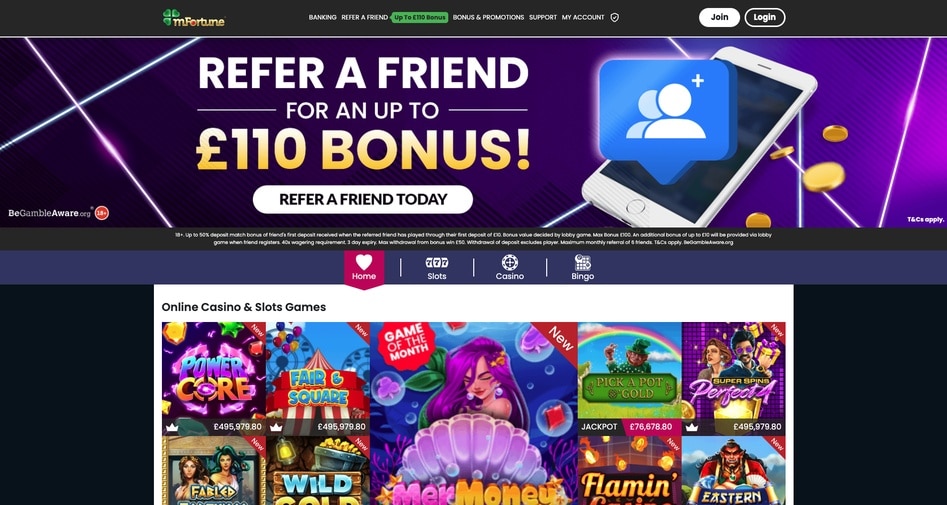
The old desktop image is useful for seeing that change. Separate product tabs and the large Mer Money tile show a browser catalogue with promotion-led navigation. The phone in the referral banner identifies the target audience; it does not turn the desktop capture into an image of the 2007 handset software. Neither version is a current service.
Why mFortune appeared on West Brom shirts
West Bromwich Albion’s August 2021 announcement identifies In Touch Games as its back-of-shirt partner for the 2021/22 season. The mFortune name was assigned to the men’s away and third shirts, and the club says the company agreed to alter the logo’s colour and style to suit those designs. The partnership helps explain why some supporters remember the casino through football rather than through its game lobby.
The club described In Touch’s move from physical slots and jukeboxes into mobile gaming, and its Black Country roots. These are dated details about the business at the time of the agreement. A sponsorship logo on an old shirt does not establish a current gambling licence, nor does it prove that the football club handled player accounts. The regulatory and operator chronology above remains the relevant history for an account enquiry.
mFortune’s original casino reviewed
mFortune’s strongest feature was the range of things it did within a relatively small in-house catalogue. It offered slots alongside casino games and bingo, with a rewards shop that gave its regular bingo audience something more distinctive than another rotating bonus banner. Its weakness was scale: even the later collection was compact beside a large multi-provider casino.
The homepage and mobile design
The original screenshot shows a large purple referral banner above separate Home, Slots, Casino and Bingo tabs. The navigation made the different products clear. Below it, the game grid mixed small tiles with a larger Game of the Month panel, giving one release much more attention than its neighbours.
That arrangement had a trade-off. The promotional banner took a substantial share of the opening screen, while the category tabs and game pictures did the more useful work of explaining the casino. The phone shown in the banner reinforced mFortune’s mobile identity, although the captured page itself was a wider desktop view.
The old downloadable-phone origins help explain why compact controls and a smaller library were part of the brand’s identity. By the smartphone era, those qualities were less unusual. Its bingo offering and loyalty shop therefore mattered more when comparing it with newer sites that also fitted comfortably on a phone.
Games and the in-house catalogue
Power Core, Fair & Square, Mer Money, Pick a Pot O’ Gold and Super Spins Perfect 10 are visible in the old homepage image. Wild Gold appears lower in the grid. Mer Money receives the largest tile and the Game of the Month label, while the other pictures use different settings and familiar slot motifs.
The earlier collection grew well beyond the four games described at launch. Historical reviews later described more than a hundred games, with slots forming the largest part. That growth gave mFortune more breadth than several of its smaller sisters, but it was still a curated in-house collection rather than a directory of major external studios.
Some themes invited comparison with better-known slots elsewhere. Power Core’s bright jewel imagery and Pick a Pot O’ Gold’s leprechaun setting were familiar visual territory. A similar appearance does not establish identical rules, payouts or underlying software. They should not be described as interchangeable versions of Starburst or Rainbow Riches.
Nor does in-house development mean every game was permanently exclusive to one website. The developer, the casino brand and the operator were related but different things. A game appearing elsewhere would not make that other casino a sister site, and the earlier catalogue should not be assumed to describe every later version of mFortune.
The old welcome offers
One historical package combined a £10 registration credit with a first-deposit promotion. Earlier descriptions called the deposit options a double or triple bonus: a 200% match up to £100, with the triple version also including one hundred spins. The first qualifying deposit was described as at least £10. These are expired offers from the earlier casino.
The headline combined several different benefits. A registration credit was not withdrawable cash, a deposit match depended on the amount paid in, and free spins had their own conditions. A 200% match on a £10 qualifying deposit would be £20 in bonus funds, rather than the full £100 cap.
Historical mFortune bonus descriptions recorded 40x wagering, cashout caps and expiry periods. Other accounts show different versions, so those conditions cannot safely be combined into one supposedly universal offer. An old dispute needs the particular promotion and terms accepted at the time.
The 40x condition illustrates why the credit headline was only part of the comparison. On £10 of eligible bonus funds, 40x represented £400 of qualifying wagers. That was betting turnover, not a promise of £400 returned or a requirement to deposit that sum. It also did not remove any separate cap on winnings or game restrictions.
The loyalty shop
The loyalty shop was mFortune’s most memorable continuing promotion. It exchanged points for bonus credit and physical gifts, rather than limiting every reward to another spin. Earlier shop examples ranged from pens and umbrellas to a lawn mower and an iPad, an unusually domestic collection for a casino.
The appeal was the variety. A small souvenir and a large electronic gift gave very different uses for points. Historical descriptions also included experience days and charitable donations. This was a more distinctive identity than another matched-deposit headline, particularly for the bingo audience around which the scheme was built.
There was an important limitation: historical accounts describe points earned through bingo, rather than every slot or casino wager. LCB’s earlier account of the loyalty scheme also records restrictions linked to deposits and gift values. A long gift catalogue was not an unrestricted cash balance or a reason to assume every player qualified for every item.
mFortune also used free-spin and deposit promotions, referral rewards and Game of the Month activity. The screenshot’s referral banner advertises up to £110, while the game grid highlights Mer Money. These show how much space continuing promotions received. All pictured amounts and shop examples belong to the former service. The old shop is no longer available.
Banking and customer support
The old cashier offered more ways to deposit than to withdraw. Earlier accounts included debit cards, PayPal, mobile payments, vouchers and other payment services, but a method suitable for adding money was not necessarily a cashout destination. The old page also named Worldpay, which is a payment-processing business rather than a customer wallet equivalent to PayPal.
Historical withdrawal estimates varied. The earlier review gave a broad one-to-five-day window, while other accounts separated processing from bank or wallet delivery. Bingo Websites’ historical banking table recorded one-to-three-day estimates for several methods. None of those estimates established an instant payout guarantee or a present service standard.
Email and chat were part of the former support setup. Some historical records also show telephone contact, so a blanket claim that mFortune never offered phone support would be misleading. Today, the original domain did not resolve during the September 2026 check. Old contact details should not be presented as a verified working helpdesk.
What the complaints show
The AskGamblers complaint archive contains repeated reports about delayed withdrawals, additional identity checks and difficulty reaching support. Its outcomes are mixed. Cases involving £5,000, £6,850 and £2,020 are marked resolved, while a missing £60 withdrawal and another delayed payment remain unresolved on the archive.
That is more informative than treating all customer experiences as identical. An allegation about a delay is not proof of a rigged game; a resolved case is not proof that every customer received prompt service. The dated exchanges help show the particular documents, payment references and follow-up that individual customers needed.
For an outstanding historical balance, gather the transaction dates, account emails, withdrawal references and any final operator response. Separate an amount still in the casino balance from a payment the operator said it had already sent. Those records help a dispute service understand the issue. The Commission’s complaints guidance explains the usual operator and dispute-resolution process; it does not promise that an old closed-business claim can still be accepted or that the regulator will recover the money.
Its early mobile games, bingo audience and unusual shop gave it a recognisable place in the In Touch family. Its limited catalogue, restrictive promotions and payment complaints also deserve attention. Both former British operator periods have ended, so those strengths explain the old casino rather than justify a new registration.
Physical gifts, bonus credit and cash were different rewards
The loyalty shop brought together rewards that could not be compared by headline quantity alone. Bonus credit was money for play subject to its conditions. A pen, umbrella or electronic item was a physical gift. A charitable donation or experience day was another type of fulfilment. The old shop’s range was distinctive, but it was not a menu for converting every point into unrestricted cash.
The distinction matters when reading an old complaint. A missing gift needs the item, redemption date and order confirmation. A bonus dispute needs the reward’s credited amount and wagering terms. An unpaid withdrawal needs the transaction reference and the operator’s payment response. Combining all three into a single claim of a missing balance can obscure what the customer actually requested.
The original screenshots and published shop examples establish the former product, not a current point exchange rate. Do not use an old points total to calculate a present entitlement or assume the later Viral operator offered the same gifts. The old agreement and redemption record are needed to identify that particular reward.
mFortune questions
Is mFortune still open in Britain?
No active British mFortune service was available at the original domain when checked. Its former In Touch Games and Viral Interactive permissions have ended, and its domain is inactive on the later operator’s record.
What were the final mFortune sister sites?
Jammy Monkey, Pocket Win, Luck.com, Lucky Casino and Mad Slots appear alongside mFortune in Viral Interactive’s inactive domain list. Luck.com and Lucky Casino are separate brands.
How was Mr Spin related to mFortune?
Mr Spin belonged to the earlier In Touch Games family. Its slots, bingo and table games made it one of the closer historical comparisons, but it does not appear in mFortune’s later Viral Interactive group.
What made the mFortune loyalty shop different?
The former bingo loyalty scheme offered bonus credit and physical gifts, with historical examples ranging from small souvenirs to electronics and experience days. Qualification and gift-value restrictions applied; it is not a current rewards programme.
Why do mFortune sister-site lists give different totals?
There were eight sisters in the earlier In Touch group and five in the later Viral group. Pocket Win and Jammy Monkey appeared in both, leaving eleven distinct former sister brands across the two periods.